
Last week, we had a special guest at Icons.
For half the conversation, audience questions began the same way: “Thank you for FSD. It changed my life.”
And after Elon Musk, there is one person who deserves much of that thanks: Ashok Elluswamy. Ashok is the head of AI at Tesla, responsible for its AI efforts across FSD and Optimus.
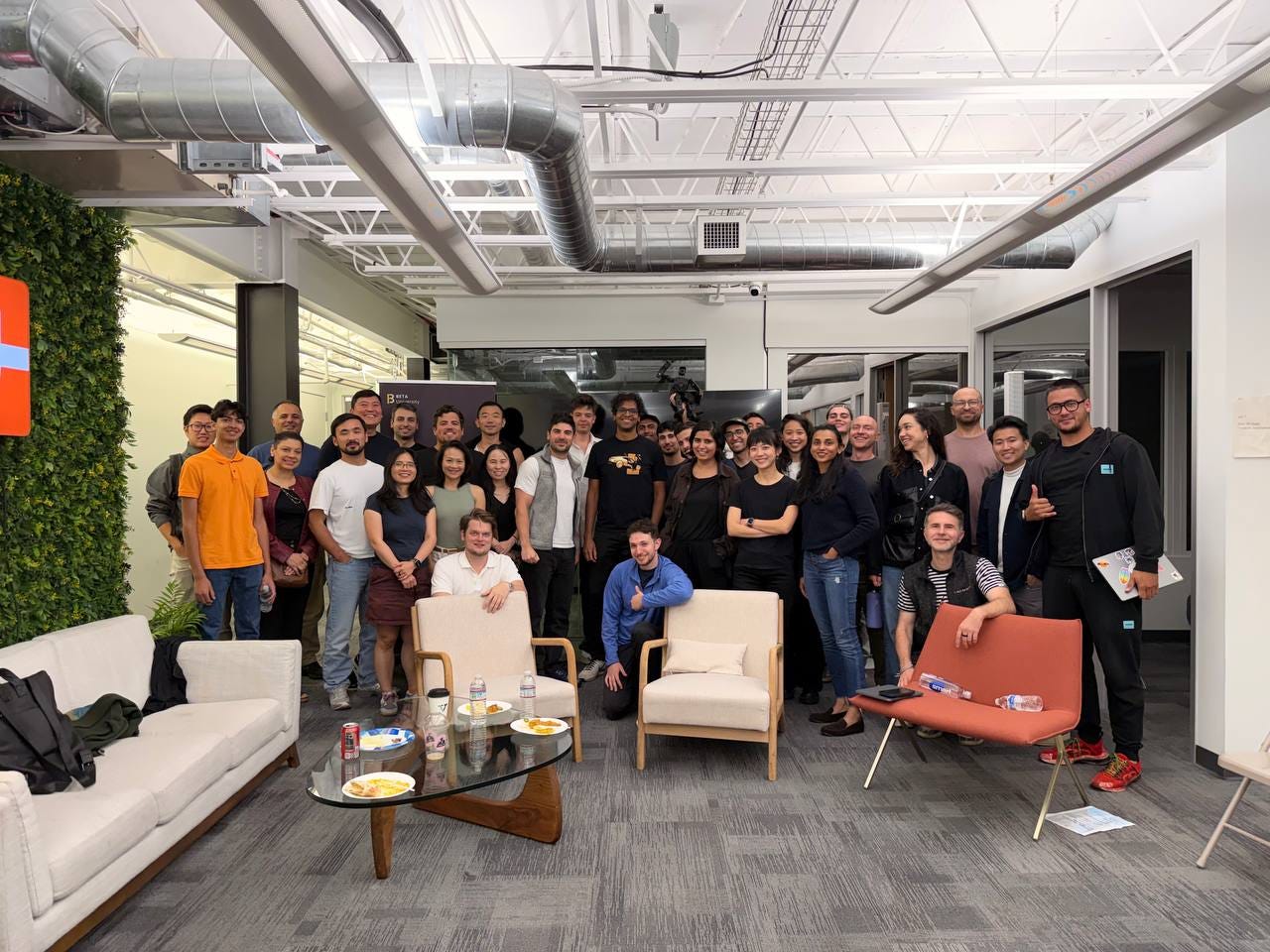
He joined Tesla as an engineer in 2014 and rose to lead its AI organization.
Here are a few takeaways from our conversation:
1. Evaluation is the bottleneck.
At the end, I asked him what the community should go build. His answer was evaluation.
“Evaluation is such a pain. That is probably the biggest problem.”
Tesla runs roughly a dozen different kinds of evaluation because no single one tells you enough. Then he shared the detail that made the room go quiet: you are trying to detect a 5% improvement with an evaluation that has 50% variance. Change nothing except the random seed you train with, and your error scores can swing wildly. At that point, how do you know whether your change actually did anything?
Building a low-variance estimate of whether your robot got better is real engineering. Almost nobody wants to fund it. Everybody wants to fund the model.
But if you are building a serious product, evaluation is the part that determines whether you actually have one.
2. The shortcut that gets you to a demo costs you the ceiling.
On LiDAR, he was direct: it gets you to market sooner. Then it slows you down.
His framing was that sensors that hand you early wins can pull you away from the right approach entirely. You take the shortcut, patch around it, and eventually find yourself crawling. Cameras give you none of those early wins. But the information is already there: five megapixels, eight cameras, thirty frames per second, and roughly two gigabytes of data arriving every second. The problem is information processing.
His allocation rule was equally direct: if you have an extra thousand dollars to spend on a self-driving car, spend it on compute, not sensors.
3. You cannot buy your way to a data moat.
Everyone in this space is buying egocentric data right now. I asked whether Tesla does the same.
His view was that purchased egocentric data is a drop in the bucket.
The point was not that data does not matter. It is necessary, but nowhere close to sufficient. How you structure the network, formulate the problem, and build the reward and evaluation around it carries much more of the weight. Having a lot of data and using it badly gets you nowhere.
This is also exactly why the humanoid form factor matters. The world is already built for humans, so you do not have to rebuild the world around the robot. More importantly, human video data transfers to human kinematics. Put a gripper or a wheel on the robot and that data stops applying. Preserve the human form and you begin much closer to the solution.
Tesla’s own factories are full of people performing exactly the tasks the robot needs to learn. That is the loop.
4. Demos are not products, and unit economics decide who survives.
Most robotics demos you see are running on a datacenter GPU bolted to the robot. That is thirty to forty thousand dollars of compute inside a machine that eventually needs to sell for around thirty-five thousand. It is also burning five hundred watts against a power budget closer to one hundred and forty.
You cannot simply offload the work to the cloud. The path from pixels to actuation is about 140 milliseconds. No round trip to a server survives that constraint. For anything safety-critical, inference happens locally or it does not happen at all.
His conclusion was that anyone serious about scale eventually designs their own silicon. The barrier at the edge is much lower than it is in the datacenter because you are not trying to compete with a complete NVIDIA system. Tesla’s chip is designed to be exceptional at exactly one shape of problem: high-dimensional video in, low-dimensional actions out.
5. General beats specialized because of economies of scale.
For any individual task, there is some form factor that is technically optimal. But every specialized robot fragments your volume, your supply chain, and your AI team. The general-purpose robot gets cheaper every year because everyone is pushing down the same cost curve. It is the same reason HBM became affordable: the entire industry standardized around needing it.
Eventually, the supposedly efficient specialized robot becomes the expensive one.
Humans are not optimal at most tasks either. They still perform most of the work in the world. Build one general form factor well enough and you can capture eighty to ninety percent of the market.
6. The problem he would work on if he could work on anything else.
Autoregressive decoding.
His reasoning was that autoregressive decoding makes memory bandwidth, rather than compute, the bottleneck. That is why HBM is the constraint and why HBM prices are heading where they are. Reformulate the problem so that it becomes compute-bound, and you can build dramatically better chips per watt and per dollar.
7. On video, simulation, and the other open gaps.
He named several other problems that remain unsolved and worth building around.
- Video supervision. Frontier training moved from text to images and is only now beginning to reach video. Because of how the objective is formulated, most of the signal contained in video gets squandered. Nobody has cracked internet-video pretraining for robotics in the way text pretraining was cracked for language.
- Simulation. Existing simulation tooling still is not good enough for this problem. He added an important caveat, though: neural simulators can be so expensive that collecting data from real robots is often cheaper. The opportunity is to build one that is cost-effective.
- Grading subjective behavior. A collision is objectively bad and straightforward to score. “Was that sudden brake appropriate?” is a much harder question. No model has developed that intuition yet, and he expects humans to remain in that loop for several more years.
- Failure data. Humans rarely fall, which means there is almost no data showing what falling looks like. Teaching a robot to fall safely, especially in a room with a child, is a whole-body planning problem that nobody has solved.
- Actuators. His warning was that magnets are constrained and actuator prices are going to spike the way memory prices did. If you are not locking down supply now, you may not have actuators when you need them.
8. On how Tesla is actually run.
I asked about the company’s hiring and firing playbook because everyone in the room is trying to build a team.
His answer was that Tesla operates like a high-performing sports team. A lot of the process is self-selection. Tesla is the wrong company for most people, but the people it is right for can do extraordinary work there. It is intense, deadlines are aggressive, and the experience can be painful in the moment.
What people get in exchange is leverage. Almost no other company would hand an engineer that much scope. There is no committee verifying every decision. It is your product. You decide what goes into it, and then you build it.
9. On whether robotics is overhyped.
I compared the current moment to crypto in 2021. He did not accept the comparison.
The models are genuinely beginning to work. The excitement is built on real material. But people badly underestimate how difficult it is to move from a working demo to something economically viable.
Hardware is hard. The long tail is long. Validation is brutal.
His sharpest business observation was to ask whether the model itself is the product. If it is, what exactly are you guaranteeing? Nobody buys unguaranteed software for high-consequence work.
That is why he does not think robotics foundation models will commoditize in the same way open-weight LLMs have. You cannot promise performance across hardware you do not control.
Thanks to Alma and Beta Univesity for supporting Icons.