
Last week we had a chance to host Jason Ma, Co-Founder and Chief Researcher and Zhipeng, head of infra at Dyna Robotics.
Dyna is building a full-stack robot platform for real workplaces.
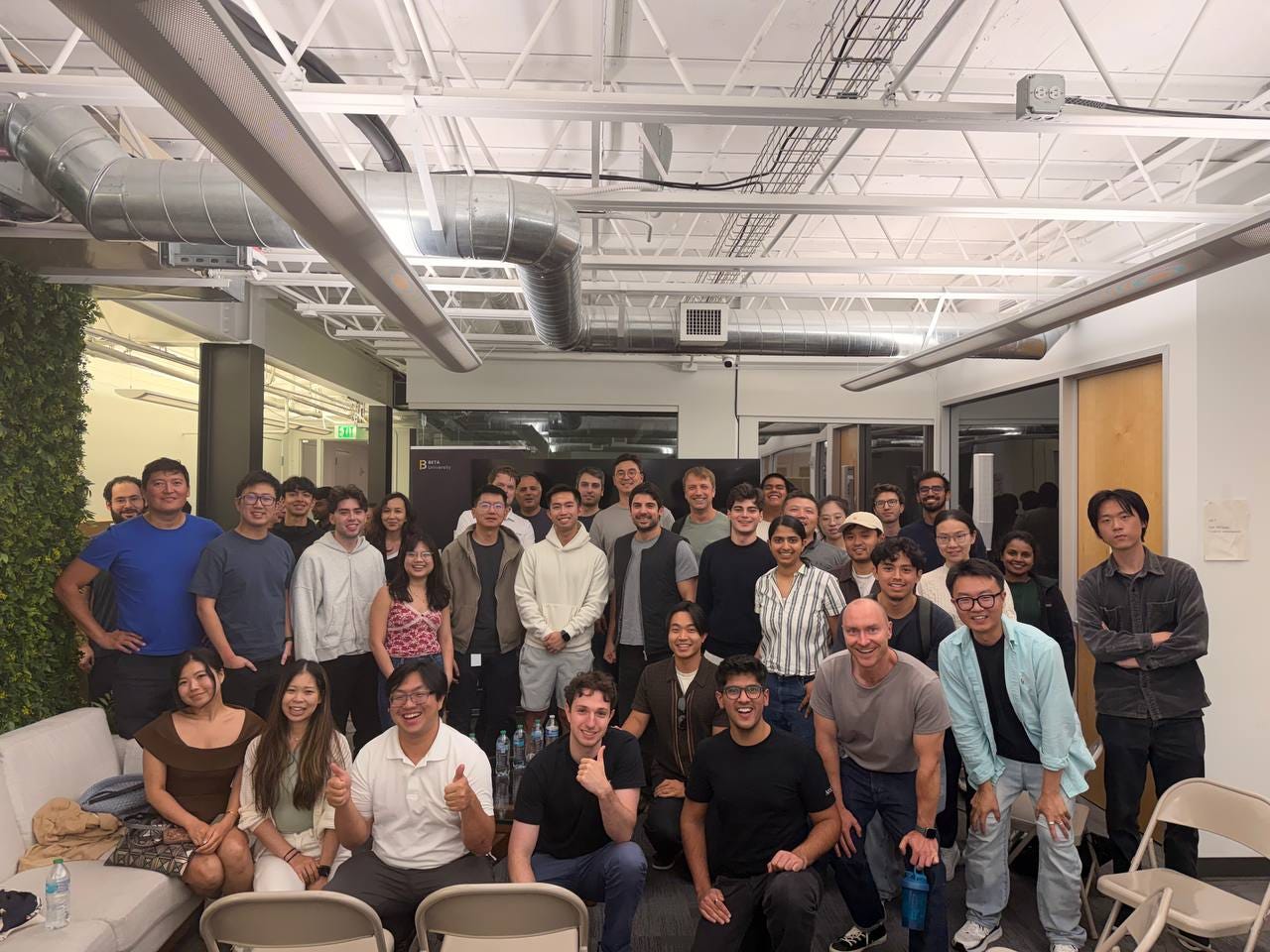
Here are our main takeaways from the session:
1/ The gap in robotics is distribution.
Jason opened with one question: where are all the robots? He means machines doing paid work in the field, not demo videos. Model and hardware get the attention, but his race is about who puts the most robots into the physical world.
2/ Own the stack or get squeezed.
A pure model company depends on someone else’s hardware. A pure hardware company depends on someone else’s model. Both get commoditized from above or below.
Customers don’t care if it’s a VLA, a world model, or a planning algorithm. They care that the towels get folded.
The robot’s body is also its sensor. Rent the arm and you rent the fidelity of your own training data. Their fortune cookie clip, a robot opening one without crushing it, shows what tight hardware and model co-design buys.
3/ Predict the world, and treat actions as one output.
VLMs read what’s in front of the robot well. They miss contact and force, because physics doesn’t compress into text. Dyna trains world-action models: predicting how the world evolves is the objective, and the robot’s actions are one piece of it.
World models run slower than VLAs, and Jason treats that as a distillation problem. A big model can plan, but control at ~100 Hz needs a small, fast one.
A stronger frontier model from someone else is upside, because Dyna plugs it in. His scoreboard is the size of the fleet in the physical world.
4/ Egocentric versus teleop is a false choice.
Human egocentric video for pretraining. Robot teleop data can’t be replaced, because a deployed robot has to keep learning on the job, like a person.
Teleop sits near 100k hours, too few points to fit a scaling law. In their human-video study, more data improved robot action prediction with zero robot data in training. They could scale to 10M hours and see more value right now in architecture and annotation quality.
Vendors get scored on utility per dollar, usable share, overlap with other vendors (many share an upstream), and delivery.
5/ Start with a task where failure is recoverable.
Drop a plate and it’s broken. Fold a towel wrong and you fold it again. That lets the model move fast and self-correct while it bootstraps.
Jason’s filter: avoid irreversible failures, pick tasks a robot completes end to end alone (shared tasks make ROI impossible to attribute), and favor tasks that build general capability over custom engineering.
Every hotel and gym wants towels folded the same way. They shipped a robot to Korea for CoRL with no extra training, and it folded towels live.
6/ “We don’t deploy premature products.”
No mass hardware production yet. A design bet at scale risks obsolescence, and early deployment buries the team in shipping, maintenance, and on-site engineers.
They’re open about gaps. A worker folds a box in 7 seconds, and their robot took about 20. Full assembly-line integration is a harder fit today than self-contained tasks.
7/ Recovery is the test of intelligence.
They aim for 100% success and treat autonomous recovery as the differentiator. Humans earn trust at work by catching and fixing their own errors. Jason called that ability almost a hallmark of intelligence.
That’s a better target than a 99.9% demo reel.
8/ Humanoids are a benchmark hedge.
Jason expects the form to dominate at some point and doesn’t see it as the endgame. Many companies build humanoids because the bar is wherever humans are.
Blockers: production difficulty, reliability, speed, and hand dexterity at industrial reliability.
9/ Payback runs in months, and valuations are a snapshot.
His math: a US worker costs around $50K a year, and many robots land at that price. Robots don’t get sick or quit, though they do break.
Physical deployments carry high switching costs once installed, so the physical economy has room for several winners. Unitree is valued above almost anyone in a three-year-old market, which he compared to how people dismissed the GPT-3 era.
They won’t sell models to other robotics companies. A deployment-only company caps its own system.
10/ Where founders should look.
Everything is open: model, data, hardware, deployment, eval. Avoid becoming another egocentric-data vendor, since that corner is crowded.
Eval is the most underinvested layer. Jason compared a rigorous eval practice to an exercise routine: discipline beats bursts.
US manufacturing and supply chain is the least mature piece. Vendors are hard to find and lead times lag the rest of the world.
11/ Hold no prior longer than three months. Maybe three weeks.
Dyna is hiring across research, hardware, software, ops, and go-to-market, with PhD interns on dexterous hand control that they let people publish.
No 996 culture, but the model runs 24/7.