
Last week, we hosted Karol Hausman, CEO and Co-Founder of Physical Intelligence for an Icons dinner.
Honestly, it felt like the moment we hosted Dario Amodei in 2022. Something big is happening, we all believe it is almost here, and it is not yet consensus. Physical AI seems like “that” thing.
Jake Saper described PI to us the week before as “Anthropic for the physical world,” and after two hours with Karol I think that framing holds.
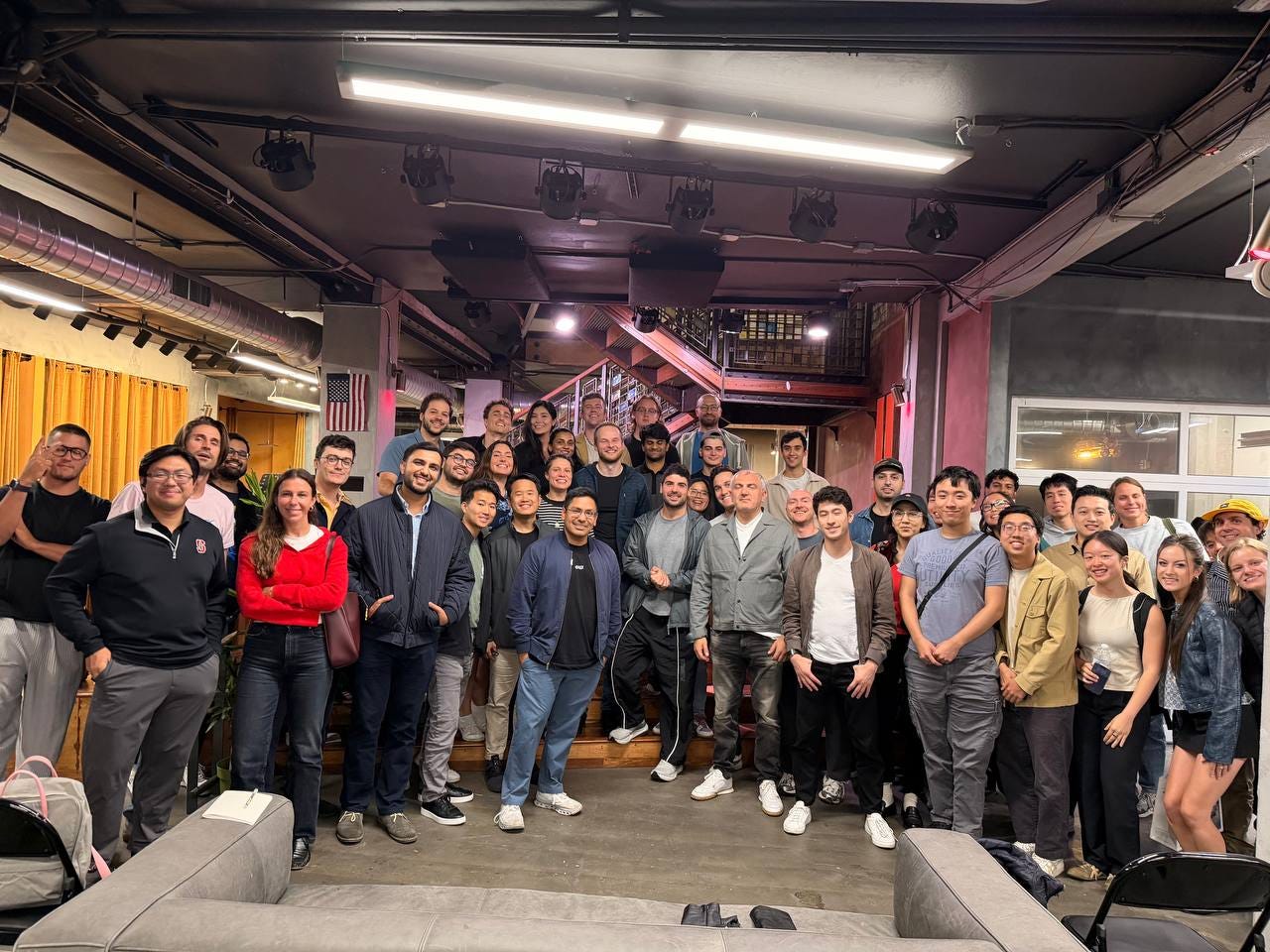
Here are a few insights from the dinner:
1. The data bottleneck is closing, and almost nobody has updated on this.
Karol’s view is that we are quickly escaping robot data scarcity. Every serious lab now collects at scale internally, and on top of that there is a wave of data companies out of YC and elsewhere doing teleop and egocentric collection. The consequence worth sitting with: if you are building a company whose whole thesis is “we supply the data,” you are entering the part of the stack that is getting solved and getting crowded at the same time.
2. The real bottleneck is the last 5%, and it comes from a misaligned objective.
This was the sharpest thing he said. These models are optimized to reproduce the actions in the dataset. What you actually care about is task success. Those two objectives diverge, so additional data on a given task stops moving you toward 100% reliability. Going from 0% to 20% to 60% zero-shot is a data story. Going from 60% to deployable is a reinforcement learning story. That is where PI is putting real effort, and he was open that nobody has cracked it.
The way they approach it: label large volumes of data with language and scores, train a generalized value function that can judge a trajectory in progress, then use that to score everything and improve the policy. The same way you can watch someone attempt a task and predict whether they will succeed.
3. Hardware reliability is the second bottleneck, and it surprised him.
Despite the enormous volume of robots coming out of China, he says there is still no platform robust enough for real deployment. Robots that stay up, stay safe around people, and survive daily use. This is a genuine gap, and it is a hardware company opportunity sitting in plain sight.
4. Cross-embodiment generalization works, and it’s not fully clear why.
The same PI model runs on humanoids, single-arm and dual-arm manipulators, drones, cars, tractors, excavators, and surgical robots. Training across more embodiments makes the model better at any individual embodiment. Karol called this extremely counterintuitive and said plainly that they cannot fully explain it. Tractors and livestock robots somehow improve manipulation.
The limit: give it a brand new robot it has never seen, and it cannot look at the body and figure out how to move. It still needs a little data from that embodiment. He expects in-context adaptation eventually.
5. Generalists beat specialists, which is the worst startup advice ever given.
His words. Normal startup logic says own a narrow wedge, dominate it, then expand. If OpenAI had followed that, they would have started with translation only. What actually happened is that breadth of data distribution made the model better at every individual task, and he expects the same to hold for robotics. So when people ask him which vertical or which task PI will nail first, his answer is: many tasks at once, embrace diversity, and that is how you get good at any single one.
6. Simulation’s near-term job is evaluation.
This reframed the sim debate for me. Evaluation does not scale: the better your model gets, the more real-world samples you need to tell whether the new one beats the old one. Thousands of physical rollouts is impractical. So sim’s first real value is a closed-loop proxy that tells you if your model improved.
On sim for data, his diagnosis is specific: the blocker is asset creation. Rendering fidelity is fine. Locomotion works in sim because you only have to model your own robot accurately. Manipulation fails because you would have to model every object in the world you touch, including how it deforms, and there is no scalable way to do that. Real-world collection is faster and carries no distribution shift.
7. Tactile sensing is overrated as a blocker.
He has worked with tactile sensors a lot and has been disappointed by how little lift they give relative to the integration pain. PI’s workaround is elegant: put a camera on the gripper, read the deformation of the gripper, and infer applied force. Now it is just another vision signal the model already knows how to consume. Tactile data is also awkward because you only get signal when you are touching something, so most of the time it is empty.
8. The VLA versus world model debate is blown out of proportion.
Companies are building their entire identity on an architectural choice you can swap in about three days. His view: data, data quality, diversity, and deployment matter far more at this stage. Worth remembering when you are diligencing robotics companies that pitch architecture as a moat.
9. Compute will be split, and inference is leaving the robot.
Models are already too large to sit entirely on the robot. The likely shape: a system-one policy on the edge handling low-level action and reflexes, and a system-two reasoner in the cloud, possibly parts of the same network. Where connectivity is bad, local inference boxes on site. Robot-specific silicon is further out, though every chip company wants it.
10. Why they chose the intelligence layer.
Every robotics company historically started with a robot they wanted to build. Everything else became subordinate to that, so the AI team stayed small and the intelligence was always the lopsided part. PI inverted it: solving physical intelligence is priority one, and hardware and software choices serve it. He had never seen a company organized this way, which is exactly why he thought it might work.
On the operating system analogy people keep reaching for: he pushed back. Operating systems work because they abstract the hardware away, and that abstraction breaks for robots, because all the complexity lives in the physical body and how it touches the world. The right abstraction sits higher, at the intelligence level, where you specify a command and any robot executes it.
11. What he would actually tell builders to work on.
Two things. Actuators in the West, because if Chinese actuators get restricted we have no domestic answer, and the supply chain problem goes deeper than most people check: rare earth refining, magnets, copper for coils, batteries, and the manufacturing know-how itself. And deployment: understanding ROI, integrating into a workflow, remote intervention, knowing when the robot should ask for help. His heuristic on where to build was blunt and worth writing down: if it is easy, it is probably the wrong place to enter, because it likely works worse than you think and everyone else is already there.
He also made the point that deployment companies end up owning the best data by accident, which everyone else will want.
12. The barrier to entry has genuinely collapsed.
Download an open model, fine-tune on a little data, get signs of life. One deployment company they work with had robots in a logistics setting three months in. That used to take five to seven years. Hardware is cheaper and intelligence is now available, which is why he thinks this is the best moment in history to start a robotics company.
13. There will be no ChatGPT moment.
He thinks it goes the way of Waymo. There was never a single Waymo moment, and then suddenly they were everywhere. Robots will show up in businesses, then industrial settings, then around people, then simple home applications, and at some point you look up and it happened.
14. First deployment will be shaped by tasks, and tasks cut across verticals.
The framework of picking a vertical may be wrong. His example: one of the tasks PI has focused on is assembling packaging boxes at a chocolate factory. You would file that under logistics, and it sits inside food. The same simple, low-variability tasks recur across industries that look unrelated. Start there, then expand into longer-horizon tasks, more human collaboration, mobility, and higher-consequence failures.
15. The home is the last problem, and privacy is a real part of it.
No two homes are alike, the task variety is enormous, and repeatability is low, so ROI per task is weak. You fold laundry twice a week. A home robot has to do many things to justify existing. On top of that: teleoperation means a stranger walking around your house, and even without teleop there is a robot collecting data in your home. He said outright that people underweight this today, and expects early adopters to opt in the way they did with Alexa.
16. On culture: run the experiment.
Most startups run on the conviction of the founder. Karol said PI would be bottlenecked by his ideas if they operated that way. What they kept from academia is the discipline of running the experiment, looking at the evidence without bias, and doubling down on what worked regardless of what you wanted to be true. His read on the history of robot learning is that most missteps happened because the honest path was hard and people believed the easier story.
17. On his own path: someone gave him a chance at every stage.
He knocked on a lab door in Munich as a student who did not know C, did not know Linux, and did not know robots. They gave him a shot anyway. Later, a visiting postdoc told him his two years of PhD work was worthless and he should be doing deep learning. He ignored him, went to his lecture that afternoon, and dropped everything the next day. That person is Sergey Levine, his co-founder. When someone asked what drives him, he credited the people who kept giving him chances.
18. Moats.
Earn the right to have one by making it work first. The moat appears naturally, because the problem is so hard.
Thanks to Alma for supporting Icons. The best immigration law firm with 99% success rate.