
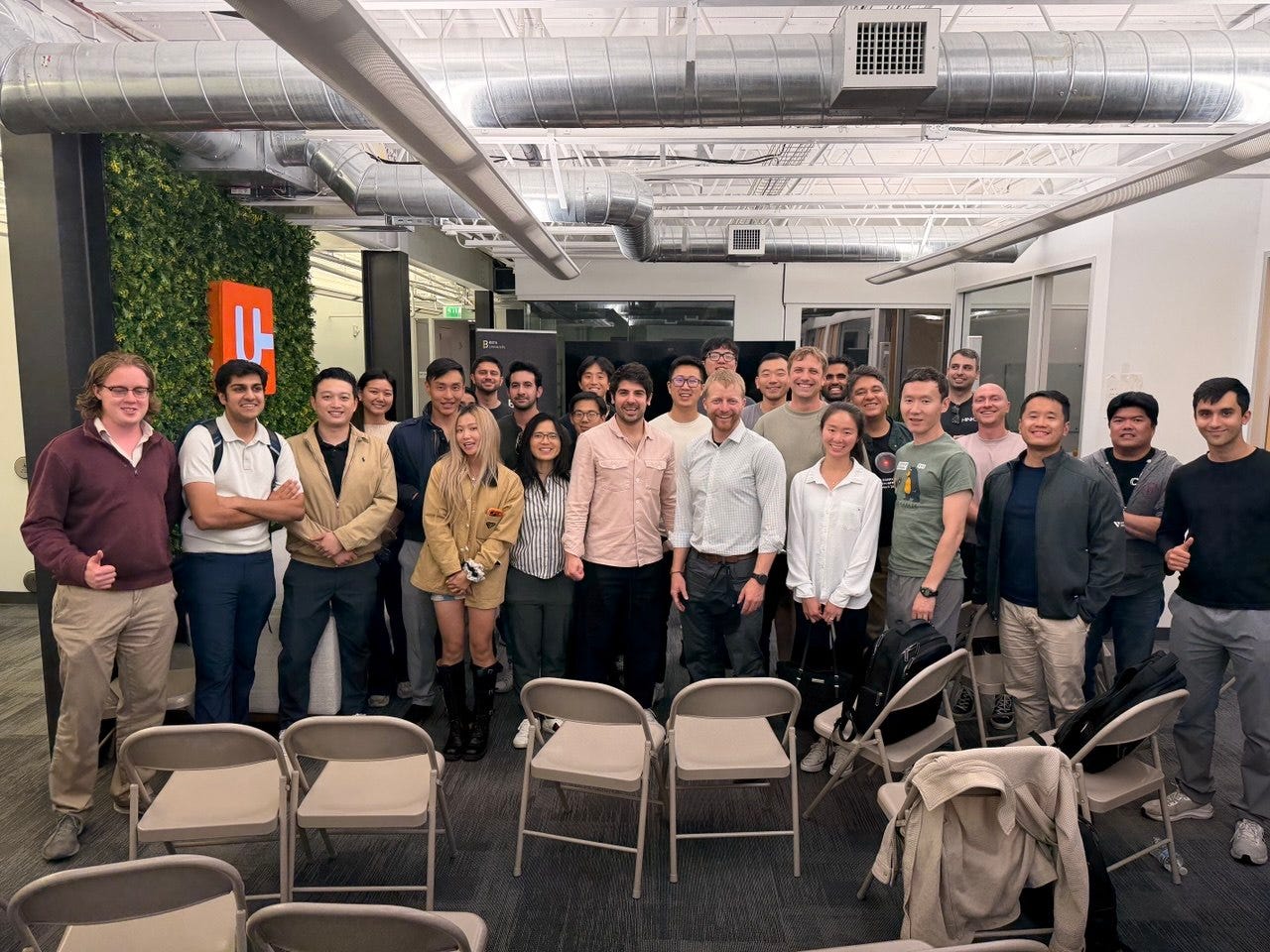
Last week we kicked off Icons Robotics Series with the first guest Lee Redden, pioneer in robotics space, co-founder of Blue River Technology (acq. by John Deere) and now LastFleet. Robotics has been one of Silicon Valley's most heavily funded sectors over the past year, and we're digging deep into where the industry is headed.
A few insights from the dinner:
On finding the problem. Lee started in a Stanford robotics lab building a new robot every month, each one cooler than the last, each one ending up on a shelf collecting dust. The turning point was deciding he wanted to build things that outlive him rather than things that impress his labmates. Lean startup gave him the method: ten customer conversations a week, treating the business as a hypothesis to be falsified before engineering time gets spent. Blue River pivoted from weeding to lettuce thinning on the back of those interviews.
On the bet that worked. The insight was importing internet-scale computer vision into agriculture at a moment when robotics conferences weren’t discussing those datasets or algorithms at all. Within four years, Blue River was thinning roughly 10% of US lettuce.
On being wrong for the right reasons. Mid-company, Moore’s Law flatlined. Lee kept re-speccing and buying the same processor three years running while the entire industry insisted the curve was intact, and the product roadmap had been built on it improving. His framing: judge a decision by whether you ran the right process on the information available, not by the outcome.
On catching the next curve. Deep learning arrived and unlocked a product they couldn’t previously build. They caught it because the unglamorous scaffolding was already in place: hardened cameras, real-time systems, tractor domain knowledge, data collection pipelines. The lesson is that the durable advantage was the boring infrastructure, not the algorithm.
On where robotics actually is. Perception is solved with a good team. Locomotion got solved about four years ago. Manipulation is the open problem, which is where the capital is going, with genuinely state-of-the-art results but unproven commercial fit. Lee’s read is that manipulation landing is the trigger for a wave of company formation, and that it hasn’t landed yet.
On simulation versus human data. A contrarian position: behavior cloning tops out and may produce commercial products in narrow domains, but not generalized ones. Human data is a bootstrap phase. His precedents are face detection trained on synthetic faces, Go self-play, sim miles in autonomous driving, and legged locomotion learned entirely in simulation. He’s also been repeatedly surprised by how crude a simulator can be and still transfer, citing a quadruped that learned to balance on a soft yoga ball modeled as a rigid sphere.
On explainability. The demand for explainability tends to disappear once the learned method outperforms the interpretable one. The more useful distinction is organizational: hand-tuning features requires PhDs and looks like a research project, while collect data, retrain, redeploy looks like an engineered product and is far more reliable to run.
On what deployed products actually look like. State of the art will look like one generalized model. Shipped products will be mostly edge-case hardening, cost engineering, and safety, with the generalized component a small block inside a much larger system. Safety belongs in its own non-negotiable bucket, even when it costs capability. Everything else is a productivity number.
On the real bottleneck. Not intelligence, manufacturing. A hundred thousand deployments requires a hundred thousand robots, and several of the best-funded companies in the category are producing on the order of one robot a day. The gap between perceived deployment and actual deployment is enormous. Lee’s response is to keep the robot cheap and simple enough to actually produce.
On the component that worries him. Motors, and only motors. Everything else has five suppliers and four-day turnaround on custom parts. He thinks motor design is still a generation or two from where it needs to be, and that the right design could take meaningful weight out of a robot while raising its capacity.
On the verticals worth building in. The boring, high-burden human ones: driving, cleaning, food. His argument is that domestic robots may be the killer application for family formation, because cleaning and laundry burden is what parents actually name when asked why they stopped at three kids.
On security. Home robots are a physical attack vector with no precedent. The uncomfortable part is that the dangerous actions are also legitimate commands, so a compromised robot doing something harmful may not look anomalous at all. His view is that the cybersecurity work here is nowhere near where it needs to be.
On advice to founders in the room. Get out of the building. Ten customers a week. Validate before you build. Building in the garage first is fine, but be honest that it’s for fun rather than for a business.
Lee is actively hiring for lastfeet engineering roles - send your CVs here jobs@LastFeet.com.