
Last week, we hosted Luis Sentins for Icons dinner. Luis is Co-founder of Apptronik, professor at UT Austin, built NASA’s humanoid before humanoids were a category.
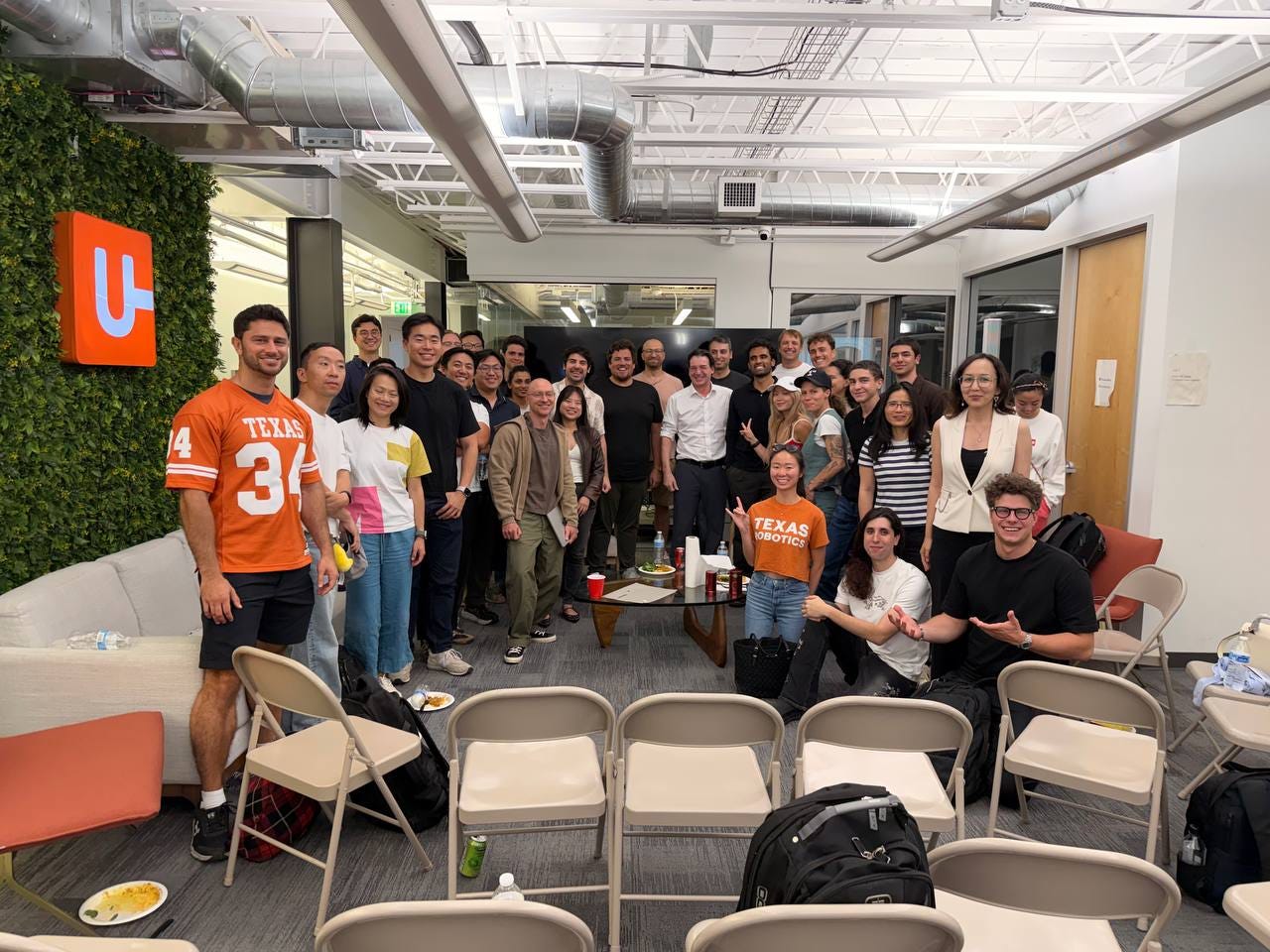
Here are a few insights from the dinner:
1. The demand is coming from plant managers.
Luis described a plant director from large OEMs. He did the math himself. One humanoid per production line. He wants to replace everyone on that floor except himself.
Workers lift parts off a rack below waist height all day and get back injuries. Insurance, complaints, union exposure. He’s buying down a liability.
2. Reliability is the product.
The target he named is 2,000 hours with no maintenance. He does not think anyone gets there soon and said so plainly. These machines fall, hit things, break hands. But four months of 24/7 with occasional calibration is enough. At that point ROI stops being a slide and becomes a purchase order.
3. Training still runs on people.
Robot parks. Hundreds of humanoids in rows, running all day, humans in wearables and VR teaching them to pick up a pillow, a can, a phone. That data feeds the foundation models. Then you fine tune on site. For one automotive customer they built a replica of the actual line and trained on the exact part being manipulated. Very little of this is autonomous today.
His guess at what deployment looks like: the robot arrives, fails a task a few times, and someone shows it five times until it works. Closer to onboarding a new hire.
4. Legs are an economics argument.
A wheeled base tips if it accelerates hard. A humanoid shifts its weight and stays up. In lean manufacturing the robot works one station, turning and reaching in a small radius. Take a five second cycle to four and a half and you beat the entire line. That is the case that survives a CFO.
He was also clear that plenty of jobs go to wheels and arms. Walking stays hard because a fall accelerates exponentially, which is why elderly people die from it and why balance is the expensive part.
5. Coordination is the next constraint.
Plants change output daily. Different volumes, different parts, different spool thicknesses. Reassigning a robot to a new line has to be as simple as telling a worker where to stand. He thinks the pieces exist and nobody has assembled them yet. That gap is a company.
6. The real bottleneck is the supply chain.
American teams wait months for components. A Chinese supplier ships a replacement humanoid in two weeks because the chain sits next door to them. If there is a squeeze, everyone here stops.
Silicon is the other half. An Orin NX runs about 1,500 dollars, an AGX about 3,000, for something that should cost a few hundred. Memory prices are off the charts. His view is that this corrects, because a robot only needs inference. Training stays in data centers you rent. The robot needs a cheap edge chip in the fifteen watt range, and the market is moving there.
He said the person he now values most is the one who can tell you which country the rare earths for your motors come from.
7. Robots will need to communicate before they need to be liked.
He is working on whole body communication. No companionship, no personality. Just a robot that can tell you the food spoiled, or signal to a line worker that something is wrong, through posture and gesture. In a factory that is a safety feature.
8. Coarse manipulation is basically solved.
Sensing has stopped being the wall. High density tactile arrays, capacitive skins, even spectroscopy that can tell you whether a fish is fresh. Now the models have to catch up to the sensing, which is a good problem to have. In hand manipulation is the frontier, and his personal benchmark is a robot that can pull a proper espresso. He is opening a lab for cooking.
The last thing.
He was candid in a way people at his level usually are not. Said engineers get locked into ignoring people and that he appreciates MBAs for exactly that reason. Gave out his phone number to the room.
That is the whole point of the format. The best part of these dinners is never the talk. It is thirty five people asking better questions than any panel would, and a speaker who answers them the way he would at dinner.
Thanks to Alma and Beta University for supporting Icons.