
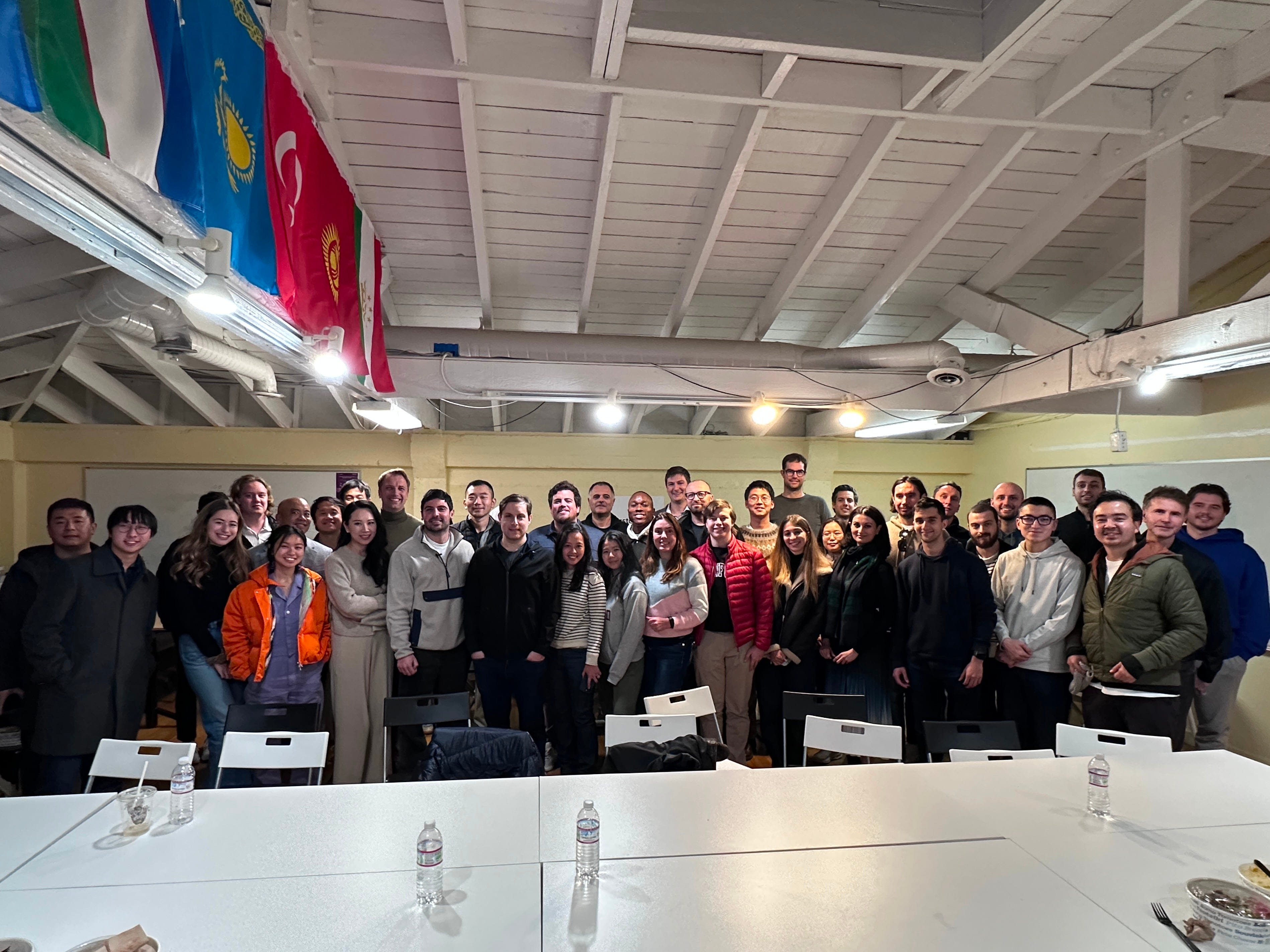
Last week, we had a chance to host Max Hodak, founder of Science and Co-Founder of Neuralink. It was one of the most phenomenal conversations we’ve had at Icons, covering topics ranging from what is the future of brain-computer interfaces to learnings that Max had after co-founding company with Elon Musk.
Here are a few insights from the conversation:
Max starts from a blunt premise: the current human condition is mediocre, and the whole point of brain–computer interfaces are not only to treat pathology, but to reengineer the human experience.
He sees the next 10 years as a phase transition: with AI and BCIs compounding at today’s pace, our world will end up either absolutely beautiful or absolutely crazy, but definitely not a slightly different version of 2025.
Max frames AI and BCIs as two distinct technological quests. If the end goal of artificial intelligence is superintelligence, the end goal of the BCI quest is a conscious machine. Classical BCIs are about reading and writing information to and from the brain—extracting motor representations to control a cursor or keyboard, or writing sensory information to restore vision, hearing, or proprioception. But he believes a non-classical form of BCI is on the horizon. Instead of reading or writing information, these systems would enable phenomenal binding over a network. That would be a fundamentally different kind of technology, and if it works, it wouldn’t just improve human capabilities – it would qualitatively transform the human condition.
Reasoning is, in his view, the most important capability humans brains have — and widespread LLM use quietly erodes it, which is why he actively restricts LLMs at work and pushes people to keep doing hard, first-principles thinking themselves.
Max co-founded Neuralink with Elon and speaks very highly of his management skills: when you put extreme urgency at the center of decision making among people with the highest level of critical thinking - impossible things become possible.
One of the big observations that Max had is that the statement of risk is overrated. People can take way higher risks but they don’t have enough agency to think clearly about such risks. He shares the example of Silicon Valley founders - almost everyone can raise money and then if things don’t work - join a big tech firm. No risk is involved.
Max describes a biohybrid approach to BCIs built from stem-cell–derived biological neurons. Instead of placing mechanical or electrical devices into the brain, the idea is to embed engineered neurons into a device and engraft it onto the brain’s surface. The question is whether those cells would grow in and form functional connections – and the answer is yes. Even a tiny graft, on the order of four millimeters by four millimeters, can integrate extensively. Because cells are small, such a device can contain on the order of a million neurons, forming billions of synapses. Max sees this as a genuinely new kind of system, and possibly the first plausible path to a whole-brain – or interhemispheric-bandwidth – neural interface.
Consciousness is independent from intelligence. LLMs have intelligence but don’t have consciousness. Conversely, non-intelligent objects might have consciousness. One of the problems with consciousness is defining it, we all know it exists, but it always has a broad definition.
Causing visual hallucinations via video is possible but the implications are very limited.
During interviews, the most important quality that Max checks is agency. Agency in making all the decisions people made to get where they are or they just followed the flow?
Max’s definition of success for someone is this: does this person have the life they wanted to have? And it doesn’t necessarily have to be rich or luxury life. Someone wants to have good work-life balance and hang out with friends - does this person have this?
His long-term economic thesis is that powerful tech will drive us into a state of abundance, and once that happens, capital and opportunity can be distributed far more equally, making today’s rich-vs-poor discourse feel oddly outdated.
Max thinks about neural engineering from the bottom up: his work is largely in low-level cognition and neural mechanics, even when he talks in terms of high-level concepts like consciousness and identity.
One of the biggest problems to scale BCI is 10 bits-per-second bottleneck of human output. You can increase input, but how can you scale output? It might be possible biohybrid approaches using stem-cell-derived neurons that integrate into the brain, and breaking by directly serializing thought.
He’s deeply interested in the “binding problem” of consciousness — how billions of neurons over space and time become a single unified “moment,” and why you only ever experience your bundle of sensory modes together rather than, say, your vision and someone else’s hearing.
His working hypothesis is that consciousness is tied to physically realized information and thermodynamics: whenever a system burns energy to stabilize a representation against entropy, you get qualia — an idea he’s honest about holding with medium-low epistemic confidence but sees as concrete enough for a real research program.
On ethics and regulation, he argues that concerns around “neural privacy” are often overstated, and that overly restrictive rules around pooling brain data are slowing down progress on exactly the science that could make BCIs safe, useful, and eventually life-changing.